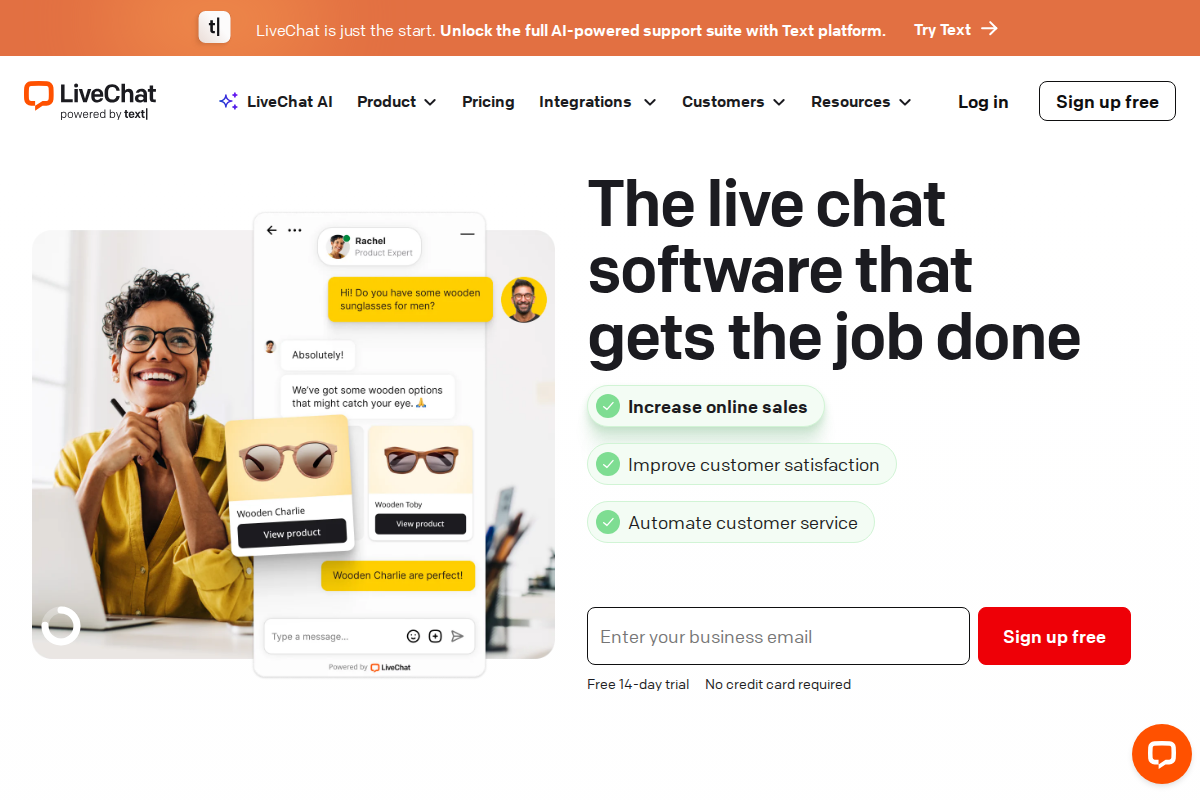
LiveChat has been a dominant player in the live chat space for nearly two decades, building a reputation as a reliable, no-fuss solution for businesses that need straightforward customer communication. In 2026, with AI-powered features becoming standard and competitors like Intercom and Tidio gaining ground, LiveChat continues to evolve while maintaining its core focus on simplicity and conversion optimization.
This review examines whether LiveChat remains the right choice for businesses seeking a dependable live chat solution, or if newer alternatives like Tidio or Intercom offer better value in today's AI-driven market. For a detailed pricing breakdown, see our LiveChat pricing analysis.
What LiveChat Actually Is
LiveChat is a customer communication platform built primarily around real-time chat, with additional features for ticketing, chatbots, and omnichannel messaging. Unlike comprehensive helpdesk platforms that try to handle email, phone, and social media equally, LiveChat focuses on doing one thing well: providing the smoothest possible chat experience for both customers and agents.
The platform targets ecommerce stores, SaaS companies, and sales-driven businesses where converting website visitors into customers is the primary goal. It's designed for teams that view chat as a sales channel first and a support channel second, with features specifically optimized for lead generation and conversion rather than complex ticket management.
Key Features Breakdown
Live Chat Widget
The core chat widget remains LiveChat's primary strength. It's fast-loading, customizable, and works reliably across devices. The interface allows agents to see what customers are typing in real-time (chat sneak peek), enabling faster responses and more natural conversation flow. Multi-language support comes standard, with the widget automatically detecting browser language settings.
File sharing, canned responses, and visitor tracking are all included. The widget integrates with most major website platforms including WordPress, Shopify, and custom sites through simple JavaScript installation.
AI-Powered Features
LiveChat has added significant AI capabilities in recent updates. The AI copilot drafts reply suggestions based on conversation context, reducing response times for common questions. AI triage automatically routes conversations to appropriate agents based on intent recognition and customer data.
Chatbot automation allows businesses to handle routine inquiries outside business hours. While not as sophisticated as Intercom's Fin AI, LiveChat's automation tools cover the essentials: lead capture, FAQ responses, and conversation routing.
Omnichannel Integration
LiveChat extends beyond website chat to include WhatsApp, Instagram, Facebook Messenger, and email. All conversations flow into a unified inbox, preventing messages from falling through cracks. This centralization is particularly valuable for ecommerce businesses managing customer inquiries across multiple platforms.
Mobile apps for iOS and Android allow agents to respond from anywhere, with push notifications ensuring timely responses even when agents are away from their desks.
Ticketing and Follow-Up
While not as comprehensive as dedicated helpdesk tools, LiveChat includes basic ticketing for chat follow-ups. Conversations can be converted into tickets with full history preserved, ensuring customers don't have to repeat information when issues require escalation.
Pricing Breakdown: What You'll Actually Pay
LiveChat uses per-agent pricing with three main tiers:
| Plan | Price Per Agent | Annual Billing | Best For |
|---|---|---|---|
| Starter | $24/month | $20/month | Small teams, 1-2 agents |
| Team | $41/month | $33/month | Growing teams, 3-10 agents |
| Business | $59/month | $50/month | Larger teams, advanced features |
Key considerations:
Starter plan covers essentials: unlimited chat history, basic widget customization, and email support. However, it lacks advanced reporting and AI features that become necessary as volume grows.
Team plan adds detailed agent performance metrics, chat routing, and priority support. This tier suits most growing businesses handling moderate chat volumes.
Business plan includes full AI capabilities, advanced automation, and dedicated account management. The $59/agent price point positions LiveChat as a premium option compared to competitors like Tidio ($29 flat) but cheaper than Intercom ($74+).
Hidden costs: Additional agents add linear costs. A 10-agent team on Team plan pays $410/month ($330 annually) — significantly more than flat-rate alternatives. SMS messaging and some integrations cost extra.
Pros: What LiveChat Does Well
Conversion-Focused Design: LiveChat is purpose-built for turning visitors into customers. Features like chat sneak peek, targeted messages based on behavior, and product carousels directly support sales objectives.
Reliability: Unlike some newer competitors, LiveChat rarely experiences downtime. The platform has matured over nearly 20 years, with infrastructure that handles high traffic without performance issues.
Ease of Setup: Most businesses can have LiveChat running within an hour. The installation process is straightforward, and the interface requires minimal training for agents.
Mobile Experience: Both the agent mobile apps and customer chat widget work smoothly on mobile devices — critical as mobile commerce continues growing.
Integration Ecosystem: LiveChat connects with 200+ tools including Salesforce, HubSpot, Shopify, and major CRM platforms. This connectivity prevents data silos and streamlines workflows.
Cons: Where LiveChat Falls Short
Limited Customization: Compared to enterprise platforms, LiveChat offers less flexibility in customizing workflows and chat behavior. The platform works well for standard use cases but may frustrate teams with unique requirements.
Per-Agent Pricing Scales Poorly: As teams grow beyond 10 agents, costs escalate quickly. Flat-rate competitors like Tidio become more economical at scale.
AI Capabilities Lag Intercom: While LiveChat has added AI features, they don't match the sophistication of Intercom's Fin AI. Teams wanting advanced automation may find LiveChat's offering basic.
No Native Helpdesk: LiveChat is chat-first with ticketing as an add-on. Businesses needing comprehensive email support alongside chat will need separate tools or integrations. For teams requiring full helpdesk functionality, platforms like Zendesk or Freshdesk offer more comprehensive solutions. Compare all options in our best live chat software guide.
Customer Support Concerns: Ironically for a customer service tool, some users report slow response times from LiveChat's own support team, particularly on lower-tier plans. This feedback appears consistently across Trustpilot reviews from 2025.
What Real Users Say About LiveChat
Overall sentiment: LiveChat holds a 4.5/5 rating on Capterra and 8/10 likeliness to recommend on SoftwareReviews, with users praising AI automation features while criticizing reliability issues and $24-$59/agent pricing.
What users consistently praise:
Capterra and SoftwareReviews users consistently highlight LiveChat's AI-powered features, specifically the AI copilot for drafting replies and AI triage for ticket routing. Ecommerce store owners on Reddit running 5+ agent teams report streamlined workflows and efficient customer engagement. The omnichannel support capabilities and chatbot automation receive specific praise for reducing response times across multiple platforms.
Recurring complaints:
Trustpilot reviews (2-3 star ratings) cite reliability problems, with users reporting inconsistent performance between browser and mobile interfaces. Multiple reviewers note the platform behaves differently across devices, creating workflow disruptions. Capterra users specifically criticize the outdated interface logic and limited customization options compared to newer competitors. Pricing starting at $24/agent/month draws complaints as teams scale, with costs escalating quickly in the $41-$59/agent range.
The non-obvious takeaway:
While pricing complaints appear frequently, a recurring pattern on Reddit reveals that teams switching from LiveChat to alternatives often cite not cost but "support response times" from LiveChat's own customer service as the breaking point — creating irony that a customer service tool struggles with its own customer service responsiveness.
Sources: Capterra, SoftwareReviews, Trustpilot, Reddit. Data aggregated February 2026.
Who Is LiveChat Best For?
Ecommerce Stores: Online retailers benefit most from LiveChat's conversion-focused features. The ability to see what customers browse, trigger messages based on cart behavior, and provide instant answers during checkout directly impacts revenue.
Sales-Driven Businesses: Companies where chat is primarily a lead generation tool rather than support channel find LiveChat aligns well with their needs. The platform prioritizes speed and conversion over complex ticketing.
Small to Mid-Sized Teams: Organizations with 2-10 support agents get the best value. Below 2 agents, cheaper alternatives suffice. Above 10 agents, per-seat pricing becomes less competitive.
Businesses Prioritizing Reliability: Companies where chat downtime means lost sales appreciate LiveChat's stability and mature infrastructure.
Who Should Skip LiveChat?
Enterprise Teams: Large organizations with 20+ agents face prohibitive costs and may find LiveChat's feature set limiting compared to enterprise-focused platforms like Zendesk or Intercom.
Budget-Conscious Startups: Teams watching every dollar may prefer Tidio ($29 flat) or even free options like Tawk.to for basic chat needs.
Complex Support Operations: Businesses needing sophisticated ticket routing, custom workflows, or extensive automation may outgrow LiveChat quickly.
AI-First Teams: Organizations wanting advanced AI automation should evaluate Intercom or specialized AI platforms rather than LiveChat's more basic offering.
LiveChat Architecture and Technical Implementation
Widget Performance and Loading
LiveChat's widget is designed for minimal page impact:
Load time: The widget typically loads in under 500ms on standard connections, with asynchronous loading that doesn't block page rendering. For performance-critical sites, the widget can be deferred until after page content loads.
Page weight: The initial script is ~50KB, with additional resources loaded on demand. This is significantly lighter than competitors like Intercom (~150KB) or Zendesk Chat (~120KB).
CDN distribution: LiveChat uses global CDN distribution, ensuring fast load times regardless of visitor location. Edge caching reduces latency for widget assets.
Mobile optimization: The widget adapts responsively to mobile screens, with touch-optimized interfaces and reduced animation to preserve battery life on mobile devices.
Customization Capabilities
While LiveChat offers less customization than enterprise platforms, businesses can still tailor the experience:
Visual customization: Colors, logos, and agent photos can be customized to match brand identity. CSS injection allows advanced styling for teams with frontend expertise.
Behavioral triggers: Display rules based on time on page, scroll depth, pages visited, and referral source. Target returning customers differently from new visitors.
Chat routing: Rules-based routing assigns conversations based on agent skills, language, availability, or customer attributes. VIP customers can be routed to senior agents automatically.
Pre-chat surveys: Collect information before conversations begin, routing more effectively and preparing agents with context.
Data and Analytics
LiveChat provides comprehensive analytics:
Real-time dashboard: Monitor active chats, queue lengths, and agent availability. Identify bottlenecks during high-traffic periods.
Agent performance: Track response times, resolution rates, customer satisfaction scores, and sales conversions per agent. Identify training needs and top performers.
Customer insights: Analyze chat volume by time of day, day of week, and traffic source. Understand when customers need help most.
Goal tracking: Define custom goals (purchases, signups, demos) and attribute them to chat interactions. Calculate ROI on live chat investment.
Data export: All data can be exported via CSV or API for analysis in external business intelligence tools.
Security and Compliance
LiveChat maintains security standards appropriate for business use:
Data encryption: TLS 1.2+ for data in transit, AES-256 for data at rest. Regular security audits and penetration testing.
GDPR compliance: Data processing agreements available, with EU data storage options. User data deletion tools and consent management features.
Access controls: Role-based permissions, IP restrictions, and two-factor authentication for agent accounts.
Data retention: Configurable retention policies. Chat transcripts can be archived or deleted based on compliance requirements.
HIPAA: Not HIPAA compliant out-of-the-box. Healthcare organizations requiring HIPAA should evaluate alternatives or implement additional safeguards.
The Verdict
LiveChat remains a solid choice for businesses prioritizing reliable, conversion-focused chat over advanced features. Its 4.5/5 Capterra rating reflects genuine user satisfaction, particularly among ecommerce stores and sales teams that value simplicity over complexity.
The platform works best when businesses accurately forecast their growth. For teams expecting to stay between 2-10 agents, LiveChat provides excellent value. However, companies anticipating rapid scaling should evaluate alternatives early, as per-agent pricing creates a cost cliff that makes migration painful.
If your primary goal is converting website visitors through fast, reliable chat — and you can justify $24-$59 per agent — LiveChat deserves consideration. For pure support operations or AI-heavy workflows, alternatives may offer better fit.
What Real Users Say About LiveChat
Overall sentiment: LiveChat holds a 4.5/5 rating on Capterra and 8/10 likeliness to recommend on SoftwareReviews, with users praising AI automation features while criticizing reliability issues and $24-$59/agent pricing.
What users consistently praise:
Capterra and SoftwareReviews users consistently highlight LiveChat's AI-powered features, specifically the AI copilot for drafting replies and AI triage for ticket routing. Ecommerce store owners on Reddit running 5+ agent teams report streamlined workflows and efficient customer engagement. The omnichannel support capabilities and chatbot automation receive specific praise for reducing response times across multiple platforms.
Recurring complaints:
Trustpilot reviews (2-3 star ratings) cite reliability problems, with users reporting inconsistent performance between browser and mobile interfaces. Multiple reviewers note the platform behaves differently across devices, creating workflow disruptions. Capterra users specifically criticize the outdated interface logic and limited customization options compared to newer competitors. Pricing starting at $24/agent/month draws complaints as teams scale, with costs escalating quickly in the $41-$59/agent range.
The non-obvious takeaway:
While pricing complaints appear frequently, a recurring pattern on Reddit reveals that teams switching from LiveChat to alternatives often cite not cost but "support response times" from LiveChat's own customer service as the breaking point — creating irony that a customer service tool struggles with its own customer service responsiveness.
Sources: Capterra, SoftwareReviews, Trustpilot, Reddit. Data aggregated February 2026.
Related Articles
- LiveChat vs Zendesk — Chat vs platform comparison
- LiveChat vs Tidio — Sales vs ecommerce chat
- Best Helpdesk for Ecommerce — Platform-specific recommendations
- How to Set Up Live Chat — Implementation guide
Migration and Implementation Timeline
Typical Deployment Schedule
Week 1: Setup and Configuration
- Day 1-2: Account creation, widget installation, basic customization
- Day 3-4: Agent account setup, canned response creation
- Day 5: Testing and refinement
Week 2: Optimization
- Day 1-2: Trigger and routing rule configuration
- Day 3-4: CRM integration setup
- Day 5: Team training and go-live preparation
Week 3: Launch and Monitoring
- Day 1: Soft launch with limited traffic
- Day 2-5: Monitor performance, adjust triggers, refine workflows
Data Migration from Other Platforms
LiveChat supports import from:
- Zendesk Chat: Direct conversation history import
- Tidio: Contact and basic conversation data
- Olark: Historical chat transcripts
- CSV: Contact lists for proactive messaging
Most migrations complete within 2-3 business days, though conversation history may be limited based on the source platform's export capabilities.
Customer Support and Resources
LiveChat provides multiple support channels:
- 24/7 Chat Support: Available on Team and Business plans with fast response times
- Email Support: Available on all plans, response within 24 hours typically
- Knowledge Base: Comprehensive documentation covering features, setup, and troubleshooting
- Video Tutorials: Step-by-step guides for common tasks
- Community Forum: User community sharing best practices and custom solutions
- Account Management: Dedicated managers on Business plan
Support quality receives mixed reviews. While 24/7 availability is appreciated, some users report inconsistent expertise levels among support agents.
Frequently Asked Questions
Is livechat worth the price?
Whether Livechat is worth it depends on your team size and feature needs. For teams that primarily need its core functionality, it offers competitive value. Larger teams should compare per-agent costs against flat-rate alternatives.
Does livechat offer a free plan?
Livechat offers a limited free option for small teams, though paid plans starting around $15-29/month unlock significantly more features. Check the pricing section above for current details.
How does livechat compare to competitors?
Livechat competes primarily on ease of use and reliability. Key alternatives include tools with different pricing models or more advanced AI features. See our detailed comparisons for side-by-side breakdowns.
Can LiveChat handle high traffic volumes?
Yes, LiveChat's infrastructure handles high concurrent chat volumes reliably. Enterprise clients report stable performance during traffic spikes and promotional periods.
Does LiveChat integrate with my ecommerce platform?
LiveChat offers native integrations for Shopify, WooCommerce, Magento, BigCommerce, and custom platforms via JavaScript. Product browsing data and cart contents are visible to agents during conversations.
Is LiveChat GDPR compliant?
Yes, LiveChat provides GDPR compliance tools including data processing agreements, EU data residency options, and user data deletion capabilities. Privacy controls are configurable per organization.
Try LiveChat Free for 14 Days
Join 36,000+ companies using LiveChat for real-time customer support. No credit card required.
Start Free Trial →
Bob B.
Senior SaaS AnalystBob covers helpdesk tools, CRM platforms, and live chat software at AgentWhispers. He focuses on in-depth reviews, industry-specific recommendations, and feature analysis to help teams find the right support stack.