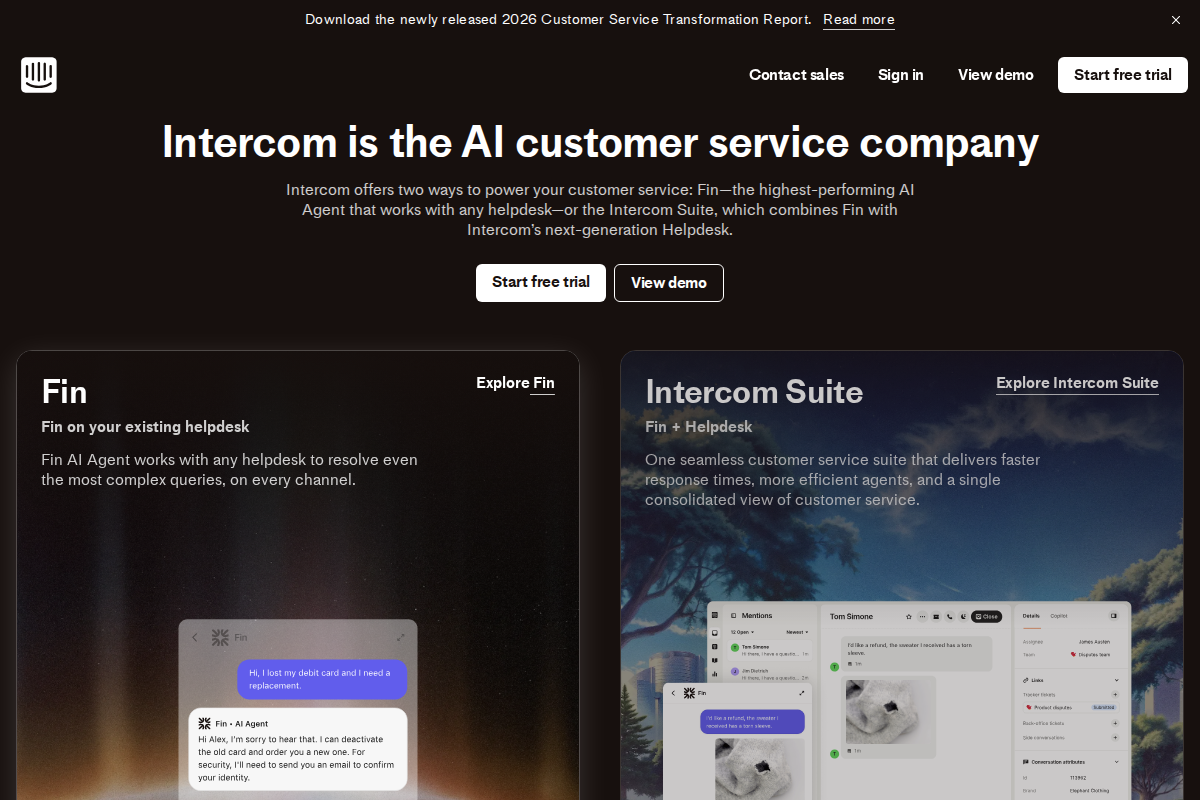
Intercom invented the modern customer messaging platform and remains the leader in proactive engagement. It's expensive — often 3-5x the cost of traditional helpdesk software — but for growth-focused companies, the ROI can justify the price.
This review examines Intercom's features, pricing, strengths, and limitations to help you decide if the premium is worth paying.
What Intercom Actually Is
Intercom is a customer communication platform combining live chat, product tours, email messaging, and a help desk. It's designed for SaaS and product companies where user engagement, activation, and retention drive business metrics.
The core philosophy: engage customers proactively, not just react to support tickets. See our Intercom pricing breakdown for detailed cost analysis.
Unlike traditional helpdesks that wait for customers to email, Intercom enables you to reach users in-app based on behavior, time, and product usage. This shifts support from reactive to strategic.
Pricing: What You'll Actually Pay
| Plan | Starting Price | Best For |
|---|---|---|
| Starter | \$74/month | Small teams starting with messaging |
| Pro | \$199/month | Growing teams needing full features |
| Premium | Custom | Large organizations with advanced needs |
Pricing model: Unlike per-agent pricing, Intercom charges based on features and user count. This can be cheaper for large teams but expensive for small ones.
Hidden costs:
- Fin AI (advanced AI): +\$0.99/resolution
- Product tours: Included in Pro+
- Advanced outbound: Pro+
- Additional seats beyond included count: Extra fees apply
Reality check: Most teams pay \$199-499/month. At 10 agents, that's comparable to Zendesk. At 20 agents, Intercom can be cheaper.
Annual discounts: 20% off when paying yearly — significant savings at higher tiers.
What's Genuinely Good
The Messenger is best-in-class. Beautiful, customizable, and feels native to your product. Users actually enjoy interacting with it — rare for support software.
The Messenger supports rich media, carousels, apps, and custom actions that make self-service feel like a native product experience, not a bolted-on chat widget.
Proactive messaging drives growth. Product tours, onboarding sequences, and targeted messages increase activation and reduce churn. Companies report 20-30% improvement in key metrics.
Fin AI is genuinely impressive. Answers questions instantly using your help center, often resolving issues without human agents. Quality is noticeably better than competitors. Compare with other options in our Zendesk vs Intercom comparison.
Unified conversation history across chat, email, and product. Customers don't care about channels — they just want help. Intercom gets this.
In-app messaging changes the game. Reach users while they're actively using your product, not just when they email support. Behavioral triggers let you message based on actions, time, and user properties.
Analytics and reporting show which messages drive engagement, activation, and revenue. This data helps optimize campaigns over time.
What's Frustrating
The price stings. \$199+/month is a lot for small teams. You need to be confident that proactive engagement drives your business before committing.
Ticket management is secondary. Intercom has tickets, but they're basic compared to Zendesk or Freshdesk. Not built for ticket-heavy operations.
Email support feels like an afterthought. The platform is built for in-app messaging; email features are lighter.
Setup is complex. You're configuring messaging workflows, product tours, and engagement campaigns. Plan for days of setup, not hours.
Overkill for simple use cases. If you just need chat support, Tidio or Zendesk Chat delivers at lower cost.
Support response times have reportedly slowed following Intercom's AI-first pivot, which feels ironic for a support platform.
Feature Highlights
Messenger
- Customizable widget with your branding
- Contextual messaging based on user data
- Rich media support (images, videos, GIFs)
- Mobile-optimized experience
- Multi-language support
- Custom actions and apps
Proactive Engagement
- Product tours and walkthroughs
- Tooltips and banners
- Onboarding sequences
- Behavioral triggers
- A/B testing for messages
- Campaign scheduling
Fin AI
- Instant answers from help center
- Conversation summarization
- Intent detection and routing
- Human handoff with context
- Quality analytics and insights
- Continuous learning
Support Tools
- Live chat with typing indicators
- Email support integration
- Help center and knowledge base
- Ticket management (basic)
- Team inbox with assignment rules
- SLA tracking (limited)
Integrations
Intercom connects with 300+ tools including Salesforce, HubSpot, Slack, Zapier, Segment, and major CRMs. The integration ecosystem is strong but not as extensive as Zendesk's.
Use Cases: When Intercom Shines
Onboarding new users: Product tours and contextual messages guide users to activation moments. Teams see 25-40% improvement in activation rates.
Reducing churn: Proactive messages to users showing disengagement signals (login frequency drops, feature usage declines) can re-engage at-risk customers.
Feature adoption: Announce new features in-app to drive adoption. Target messages to users who haven't tried the feature yet.
Support deflection: Fin AI resolves 40-60% of common questions without human intervention, reducing support load.
Collecting feedback: In-app surveys and NPS collection reach users contextually, improving response rates.
Platform Architecture and Technical Considerations
Messenger SDK Implementation
Intercom's Messenger requires JavaScript SDK installation on your website or mobile app. Implementation is straightforward for standard web applications:
``javascript // Basic installation window.intercomSettings = { api_base: "https://api-iam.intercom.io", app_id: "YOUR_APP_ID", user_id: "USER_ID", name: "User Name", email: "user@example.com" }; ``
Performance impact: The Messenger loads asynchronously and typically adds 100-200KB to page weight. For performance-critical applications, lazy loading is recommended.
Mobile considerations: iOS and Android SDKs provide native performance but require app store updates for Messenger changes. This creates release dependencies that product teams must plan around.
Identity verification: Intercom supports identity verification via HMAC signatures to prevent impersonation. This is essential for security but requires backend development to implement properly.
Data Model and Privacy
Intercom collects extensive user data including:
- Contact information (email, phone, company)
- Behavioral data (pages viewed, features used, time spent)
- Conversation history across all channels
- Custom attributes you define
GDPR compliance: Intercom provides data processing agreements, data retention controls, and user deletion tools. However, the extensive data collection may require privacy policy updates and consent mechanisms.
Data residency: EU data centers available for organizations requiring GDPR-compliant data storage. Enterprise plans support data residency selection during setup.
API and Developer Experience
Intercom's REST API supports:
- Contact and company management
- Conversation creation and retrieval
- Data export and reporting
- Custom attribute management
- Webhook configuration for real-time events
Rate limits apply: 1,000 requests per minute for standard plans, higher for Enterprise. The API is well-documented but developers report occasional inconsistencies between documented behavior and actual responses.
Webhook reliability: Intercom sends webhooks for conversation events, user updates, and administrative changes. Implement webhook verification and retry logic for production reliability.
Who Should Use Intercom
Choose Intercom if:
- You're a SaaS or product company
- User activation and retention drive revenue
- You're willing to pay premium for engagement features
- Proactive messaging matters more than ticket handling
- You have 5-50 team members
- Budget allows for \$200+/month
- You need in-app messaging capabilities
- You have development resources for implementation
Skip Intercom if:
- You're primarily handling reactive support tickets
- Budget is tight (consider Freshdesk or Tidio)
- You need sophisticated ticket management (consider Zendesk)
- You're a traditional business (retail, services)
- Email is your primary support channel
- You need extensive SLA management
- You lack technical resources for SDK implementation
Alternatives to Consider
Zendesk: Better for ticket-heavy operations. More comprehensive, less expensive. See our Zendesk vs Intercom comparison.
Freshdesk: Better value for traditional support. Lacks Intercom's engagement features but handles tickets well.
Tidio: Better for ecommerce chat. Fraction of the cost with solid automation.
HubSpot: Better if you want CRM + messaging unified. Less expensive for similar reach with marketing automation included.
Crisp: Flat-rate pricing makes it significantly cheaper for larger teams. Good live chat but lighter on proactive features.
What Real Users Say About Intercom
Overall sentiment: Intercom receives mixed reviews with praise for AI capabilities but criticism for pricing exceeding \$100/agent/month and slow support response times, particularly following the shift to AI-first positioning.
What users consistently praise:
Headwestguide and Sparrowdesk reviews highlight Intercom's comprehensive customer interaction platform, with the Messenger serving as a centralized hub for personalized communication. The Fin AI chatbot receives specific praise for resolving up to 50% of support queries autonomously. Integration capabilities with major CRMs and the visual workflow builder satisfy teams wanting sophisticated automation. Enterprise users value the omnichannel approach combining in-app messaging, email, and chat into unified customer profiles.
Recurring complaints:
Trustpilot reviews document frustration with slow support response times — ironic given Intercom's positioning as a support platform. Pricing criticism dominates recent reviews: Featurebase notes costs often exceed \$100/seat/month with hidden AI resolution fees (\$0.99 per AI resolution adds ~\$1,000/month at 1,000 automated inquiries). Chameleon and Reddit r/SaaS users report aggressive pricing hikes and complex seat-based licensing that forces "awkward access patterns" where teams limit logins despite needing broader visibility.
The non-obvious takeaway:
Reddit r/ProductManagement discussions reveal a pattern where Intercom's AI-first pivot created a bifurcated user base — companies wanting advanced automation praise the direction while those needing reliable traditional support express frustration, suggesting Intercom's strategic shift satisfied one market segment while creating tension with another.
Sources: Headwestguide, Sparrowdesk, Trustpilot, Featurebase, Chameleon, Reddit. Data aggregated February 2026.
Implementation and Setup
Timeline expectations:
- Basic Messenger setup: 1-2 hours
- Customization and branding: 4-8 hours
- Help center configuration: 1-2 days
- Product tours setup: 2-4 days
- Advanced workflows: 1-2 weeks
Data migration: Intercom provides import tools for contacts and conversations from Zendesk, Freshdesk, and CSV files. Most migrations complete in 1-3 days depending on data volume.
Training needs:
- Agents: 4-8 hours to learn the inbox and messaging interface
- Admins: 1-2 weeks to master campaign creation and workflow automation
The Bottom Line
Intercom is expensive but delivers unique value for product companies. If user engagement, activation, and retention are critical to your business, Intercom's proactive messaging can drive ROI that justifies the cost.
For traditional support operations or budget-conscious teams, simpler tools deliver better value. The key question: does proactive engagement drive your core business metrics? If yes, Intercom is worth serious consideration. If no, look elsewhere.
Related Articles
- Intercom Pricing Breakdown — Complete cost analysis
- Zendesk vs Intercom — Feature comparison
- Best Helpdesk for Startups — Alternatives for growing teams
- How to Choose Helpdesk Software — Decision guide
Frequently Asked Questions
Is Intercom worth the price?
For SaaS companies where engagement drives retention, yes. For traditional support, no. Calculate ROI based on churn reduction and activation improvement.
Can Intercom replace my helpdesk?
Partially. It handles chat and light tickets well, but heavy ticket operations need Zendesk or Freshdesk. Many teams use Intercom for engagement + a helpdesk for tickets.
How is Intercom different from Zendesk?
Intercom is proactive engagement first, support second. Zendesk is support first, engagement second. Intercom reaches out; Zendesk responds.
What's the minimum team size for Intercom?
Technically 1, but practical minimum is 3-5 people. Below that, cheaper tools make more sense. The platform's value increases with team size up to about 50 agents.
Does Intercom integrate with Salesforce?
Yes, though not as deeply as Zendesk's Salesforce integration. For heavy Salesforce users, Zendesk may be the better choice.
What's Intercom's biggest weakness?
Ticket management. If you run a traditional support queue with complex routing and SLAs, Intercom will frustrate you. It's built for conversational support, not ticket factories.
Can Intercom handle high volumes?
Yes, but differently. High volume in Intercom means many conversations, not many tickets. The platform handles concurrent chats well but isn't designed for ticket backlogs.
Is Intercom good for mobile apps?
Excellent. The mobile SDK is one of Intercom's strongest features. In-app messaging, push notifications, and user guidance work seamlessly on iOS and Android.
How long does Intercom setup take?
1-2 weeks for basic setup, 4-6 weeks for advanced workflows. The Messenger customization is fast; building effective product tours and campaigns takes time.
Does Intercom offer discounts?
Startups in certain accelerators (Y Combinator, Techstars) qualify for discounts. Nonprofits receive 15% off. Annual billing saves 20%.
Can Intercom replace my entire helpdesk?
For conversational support, yes. For ticket-heavy operations with complex routing and SLAs, no. Many companies use Intercom alongside a dedicated helpdesk like Zendesk—Intercom for proactive engagement and chat, Zendesk for email tickets and complex workflows.
How accurate is Fin AI?
Fin AI typically resolves 40-60% of conversations without human intervention, depending on knowledge base quality. Accuracy improves with comprehensive documentation and regular training. Fin is notably more accurate than basic chatbots but less capable than human agents for complex issues.
Does Intercom work for B2B companies?
Yes, particularly for product-led growth B2B companies where user activation drives revenue. Traditional B2B sales processes with long cycles may find Intercom's engagement model less valuable than account-based approaches.
What's the learning curve for Intercom?
Basic usage (responding to chats) takes hours to learn. Building effective product tours and automation workflows requires days of practice. Mastering the platform for strategic engagement takes weeks. Plan for ongoing learning as new features release.
How does Intercom handle data privacy?
Intercom maintains GDPR compliance with EU data centers, data processing agreements, and user deletion tools. However, the platform collects extensive behavioral data, which may require privacy policy updates and consent mechanisms.
Can I export my data from Intercom?
Yes, Intercom provides data export tools for contacts, conversations, and company records. Exports available in CSV and JSON formats. Note that conversation formatting may not transfer perfectly to other platforms.
Is Intercom suitable for non-SaaS businesses?
Ecommerce and membership businesses can benefit from Intercom's proactive messaging. Traditional retail, services, and manufacturing companies may find the engagement model mismatched with their customer relationships.
How does Intercom pricing scale?
Intercom charges based on features (plan tier) and user count (people reached). Unlike per-agent pricing, costs grow with your user base regardless of team size. This can be economical for small teams with large audiences but expensive for large teams with small audiences.
What's Intercom's uptime guarantee?
Intercom publishes 99.9% uptime SLA on paid plans. Enterprise customers receive financial credits for downtime exceeding SLA limits. The platform generally maintains high availability, though occasional outages affect all customers simultaneously due to shared infrastructure.
How does Intercom's pricing compare to competitors?
At 5-10 agents, Intercom ($199-499/month) costs more than Zendesk ($95-550/month) but less than enterprise Salesforce Service Cloud. At 20+ agents, per-agent pricing from competitors often exceeds Intercom's flat-rate model. Calculate total cost based on your team size and feature needs.
Can I use Intercom for email marketing?
While Intercom includes email capabilities, it's designed for targeted, behavior-based messages rather than bulk marketing campaigns. For comprehensive email marketing, dedicated platforms like Mailchimp or HubSpot Marketing Hub provide better functionality.

Bob B.
Senior SaaS AnalystBob covers helpdesk tools, CRM platforms, and live chat software at AgentWhispers. He focuses on in-depth reviews, industry-specific recommendations, and feature analysis to help teams find the right support stack.