Running an online store means you lose most visitors before they ever reach checkout. Industry data puts average ecommerce cart abandonment around 70%. That is not a rounding error. That is seven out of ten potential buyers walking away from your store without spending a dollar.
Live chat and chatbot tools exist to close that gap, and Tidio has become one of the most popular options for ecommerce businesses specifically. Over 300,000 businesses worldwide use the platform, and a large percentage of those are online stores running on Shopify, WooCommerce, and BigCommerce.
But popularity does not always mean it is the right fit. In this guide, we will dig into what Tidio actually does for ecommerce stores, where it falls short, how it compares to alternatives, and whether the pricing makes sense for your specific situation.
If you want the short version: check our Tidio review for an overall assessment, or use our stack recommender to find the best tool for your store size and budget.
Why Ecommerce Stores Need Live Chat in 2026
The days of "submit a ticket and wait 24 hours" are over for online retail. Shoppers expect answers while they are still on the product page, not after they have already moved on to a competitor. Research from multiple sources shows that live chat can increase conversion rates by anywhere from 10% to 40%, depending on how proactively it is deployed.
For ecommerce specifically, the value is not just in answering questions. It is in catching buyers at decision moments: when they are comparing two products, confused about sizing, unsure about shipping times, or hesitating at checkout. A well-timed chat message at any of those points can turn a bounce into a sale.
The challenge is that most small and mid-sized stores cannot afford a full support team staffing chat around the clock. That is where chatbot automation comes in, and it is the reason tools like Tidio, LiveChat, and Gorgias have gained so much traction in the ecommerce space.
What Tidio Brings to Ecommerce Stores
Tidio is not a general-purpose helpdesk that happens to have a chat widget. The platform was built with ecommerce in mind from the beginning, and that shows in several ways.
Real-Time Visitor Tracking
When someone lands on your store, Tidio shows you what pages they are browsing, what products they have viewed, and how long they have been on the site. Your support agents can see a live list of every visitor and proactively start conversations with the ones who look like they need help.
This is particularly useful for high-value product pages. If someone has been staring at a $200 item for three minutes without adding it to cart, that is a signal. A quick "Hey, do you have any questions about this product?" can make the difference between a sale and a lost visitor.
Lyro AI Chatbot
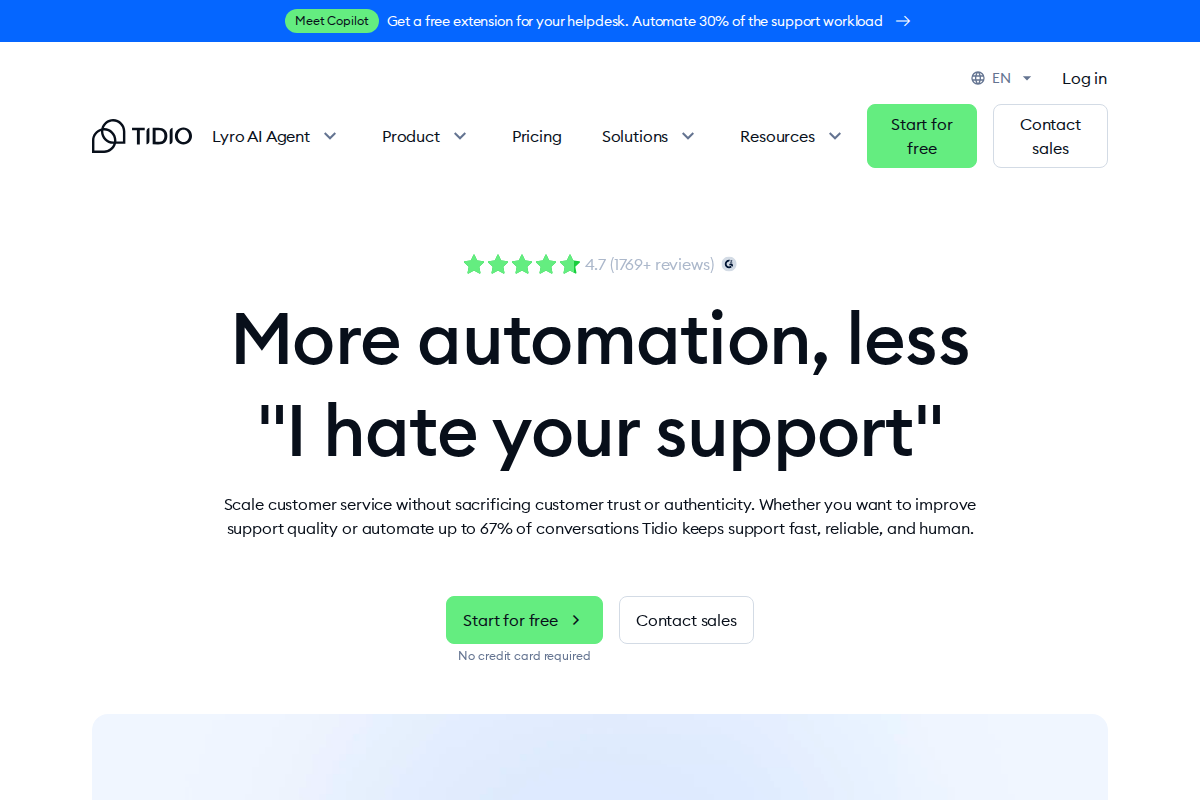
Lyro is Tidio's AI-powered chatbot, and it is the feature that separates Tidio from basic live chat tools. According to Tidio's published data, Lyro can resolve up to 67% of common customer questions without any human involvement.
For ecommerce, that means order status inquiries, return policy questions, shipping time estimates, and product availability checks can all be handled automatically. You train Lyro on your existing help content and FAQ pages, and it starts answering questions in your brand's voice.
The practical result: your human agents spend their time on complex issues and actual selling, not copy-pasting the same return policy for the fifteenth time today.
Cart Recovery Flows
This is where Tidio earns its keep for most ecommerce stores. The Flows system lets you build automated chatbot sequences triggered by specific visitor behavior. The most valuable one for online stores is cart abandonment recovery.
When a visitor adds items to cart but starts to leave, Tidio can trigger a chat message offering help, a discount code, or a reminder about the items they selected. Ad Hoc Atelier, a fashion retailer, reported a measurable reduction in their 83% cart abandonment rate after implementing Tidio's live chat and proactive messaging.
You can also set up Flows for first-time visitor greetings, product page engagement, checkout assistance, and post-purchase follow-up. Each Flow is built with a drag-and-drop editor, so you do not need a developer.
Product Recommendations in Chat
Tidio can insert product cards directly into chatbot conversations. When a customer asks about a specific type of product, the chatbot can show clickable product cards with images, prices, and "Add to Cart" buttons without the customer ever leaving the chat window.
This turns customer support into an active sales channel. Instead of just answering questions, the chatbot is recommending products based on the conversation context and the customer's browsing history.
Multi-Channel Inbox
Ecommerce customers reach out through everything: your website chat, Facebook Messenger, Instagram DMs, WhatsApp, and email. Tidio pulls all of these conversations into a single dashboard so your team does not have to switch between six different tabs.
For stores that sell through social media, this is essential. A customer might ask about a product on Instagram, then follow up via website chat the next day. Tidio keeps that conversation history connected so your agent knows exactly what was discussed before.
Pricing for Ecommerce Stores
Tidio uses conversation-based pricing rather than per-agent pricing, which can be both a benefit and a risk for ecommerce stores with variable traffic.
Here is the current plan breakdown:
Free Plan: 50 conversations per month, basic live chat, 50 Lyro AI conversations. Good for stores just starting out or testing the platform.
Starter ($29/month): 100 conversations, basic analytics, live visitor list. Works for small stores with moderate chat volume.
Growth ($59–$349/month) — 250–2,000 conversations, advanced analytics, no Tidio branding (add-on), team permissions. This is the plan most growing ecommerce stores end up on.
Plus ($749/month): Custom conversation limits, dedicated success manager, API access. For larger operations.
Premium (from $2,999/month): Managed AI implementation with guaranteed 50%+ resolution rate. Enterprise-level.
The catch to watch for: Lyro AI conversations and Flows are separate add-ons. If you want both AI chatbot responses and automated Flows beyond the free limits, your actual monthly cost will be higher than the base plan price. For a Growth plan store using both add-ons, expect to pay somewhere around $150–$250 per month in practice.
For a detailed cost breakdown, see our Tidio pricing analysis. You can also compare costs across tools using our pricing calculator.
Tidio vs. Other Ecommerce Chat Tools
How does Tidio stack up against the other major options for online stores?
Tidio vs. LiveChat: LiveChat is the more mature platform with a wider integration ecosystem and stronger analytics. Tidio wins on AI chatbot capabilities (Lyro vs. LiveChat's more basic automation) and pricing for small stores. If you are choosing between them, see our full Tidio vs. LiveChat comparison. For stores focused on ecommerce, also check LiveChat for Ecommerce.
Tidio vs. Gorgias: Gorgias is purpose-built for ecommerce support with deep Shopify integration, including the ability to cancel orders, change addresses, and process refunds directly from the help desk. If your store handles high volumes of post-purchase support, Gorgias may be the better fit. Tidio is stronger on proactive sales chat and AI-powered pre-purchase engagement. Read our Gorgias review for the full picture.
Tidio vs. Zendesk: Zendesk is enterprise-grade helpdesk software that can handle ecommerce but was not built for it. The pricing reflects that — Zendesk's entry point is significantly higher than Tidio's, and the setup complexity is in a different league. For stores under 50 employees, Tidio is almost always the better choice. See our LiveChat vs. Zendesk comparison for more context on how the big players compare.
Setting Up Tidio for Your Online Store
Getting Tidio running on most ecommerce platforms takes about 15 to 30 minutes. The process varies slightly depending on your platform:
Shopify: One-click install from the Shopify App Store. Search "Tidio," click install, and the chat widget appears on your store automatically. If you run a Shopify store specifically, our Tidio for Shopify Stores guide covers the dedicated Shopify features in detail.
WooCommerce: Install the Tidio WordPress plugin, activate it, and connect your account. The widget deploys on all pages by default — you can customize which pages show it.
BigCommerce, Wix, Squarespace: Each has a dedicated integration path. Tidio provides platform-specific setup guides in their documentation.
After installation, the first things to configure are your chat widget appearance (match your store's colors and branding), business hours (so the widget shows "away" messaging outside operating hours), and at least one welcome Flow for new visitors.
For a broader walkthrough on getting chat up and running, check our live chat setup guide.
Where Tidio Falls Short for Ecommerce
No tool is perfect, and Tidio has specific limitations that matter for ecommerce stores.
Conversation limits can get expensive fast. During sales events like Black Friday or holiday promotions, your chat volume might spike 3–5x above normal. On conversation-based pricing, that means your Tidio bill spikes too. Some stores get caught off guard by this during their busiest month.
Lyro's AI is only as good as your content. If your FAQ page and help center are thin or outdated, Lyro will struggle to give accurate answers. You need to invest time in building out comprehensive support content before the AI can perform well. This is not a plug-and-play solution for stores that have zero existing documentation.
Advanced features are locked behind higher tiers. Analytics, team permissions, and the removal of Tidio branding all require the Growth plan or above. Small stores on the Free or Starter plan get a fairly limited experience.
No built-in order management. Unlike Gorgias, Tidio cannot process refunds, cancel orders, or make shipping changes from within the chat interface. Agents need to switch to your ecommerce admin panel for those actions.
Who Should Use Tidio for Ecommerce?
Tidio fits a specific profile best:
Small to mid-sized online stores (1–20 employees) that want live chat and chatbot automation without enterprise pricing. If you are running a Shopify or WooCommerce store doing anywhere from $10K to $500K per month in revenue, Tidio's Growth plan is probably the sweet spot.
Stores that need proactive sales chat. If your main goal is catching visitors before they leave and converting browsers into buyers, Tidio's combination of real-time visitor tracking, product recommendations, and cart recovery Flows is hard to beat at this price point.
Teams with limited support staff. Lyro's AI handling 50–67% of incoming questions means a two-person support team can handle the chat volume of a much larger operation.
For stores with heavier post-purchase support needs, or stores processing more than 2,000 conversations per month, it is worth comparing Tidio against Gorgias and HelpDesk before committing.
You can also run both tools through our stack recommender to see which matches your specific requirements.
The Bottom Line
Tidio is one of the strongest options available for ecommerce stores that want to combine live chat, AI chatbots, and automated sales Flows in a single platform. The free plan makes it easy to test, the Shopify integration is solid, and the Lyro AI chatbot handles routine questions well enough to meaningfully reduce support workload.
The conversation-based pricing model can become a factor as you scale, and you should plan for the add-on costs of Lyro and Flows beyond the base plan. But for most small to mid-sized online stores, the return on investment from recovered carts and converted browsers makes the cost easy to justify.
Start with the free plan, set up a cart recovery Flow, and measure the results for 30 days. The data will tell you whether it is worth upgrading.
Frequently Asked Questions
Is Tidio good for ecommerce?
Yes. Tidio was designed with ecommerce as a primary use case. Features like cart abandonment Flows, product card recommendations inside chat, real-time visitor tracking, and native Shopify integration all target online store workflows specifically. Over 300,000 businesses use the platform, with ecommerce stores making up a large percentage of that base.
How much does Tidio cost for an online store?
Tidio starts with a free plan (50 conversations/month). Paid plans range from $29/month (Starter) to $349/month (Growth, highest tier). Most growing ecommerce stores land on the Growth plan at $59–$150/month, but add-on costs for Lyro AI and Flows can push the total higher. Check our Tidio pricing breakdown for the full math.
Can Tidio recover abandoned carts?
Yes. Tidio's Flows system includes pre-built templates for cart abandonment recovery. When a visitor adds items to their cart and shows exit intent, Tidio can trigger a chat message with a reminder, offer assistance, or present a discount code. This is one of Tidio's highest-ROI features for ecommerce.
Does Tidio work with Shopify?
Tidio has a dedicated Shopify integration available as a one-click install from the Shopify App Store. It includes Shopify-specific features like cart preview, order history in chat, native Shopify actions, and product card recommendations. The app has a 4.8-star rating on the Shopify App Store. See our detailed guide on Tidio for Shopify Stores.
How does Tidio compare to Gorgias for ecommerce?
Tidio is stronger on proactive sales engagement (cart recovery, product recommendations, AI chatbot for pre-purchase questions). Gorgias is better for post-purchase support with direct order management capabilities (cancel orders, process refunds from the help desk). Smaller stores typically start with Tidio; high-volume stores with heavy support needs often prefer Gorgias. Read our Gorgias review for a deeper comparison.
Can Tidio's AI chatbot handle product questions?
Lyro, Tidio's AI chatbot, can answer product questions when trained on your existing content. It pulls from your FAQ pages, help center articles, and any documentation you provide. According to Tidio, Lyro resolves up to 67% of common inquiries without human involvement. The quality depends heavily on how comprehensive your source content is.
Try Tidio Free — AI Chat for SMBs
Live chat + AI chatbot combo for small businesses. Free plan with 50 conversations/month.
Get Started Free →
Bob B.
Senior SaaS AnalystBob covers helpdesk tools, CRM platforms, and live chat software at AgentWhispers. He focuses on in-depth reviews, industry-specific recommendations, and feature analysis to help teams find the right support stack.