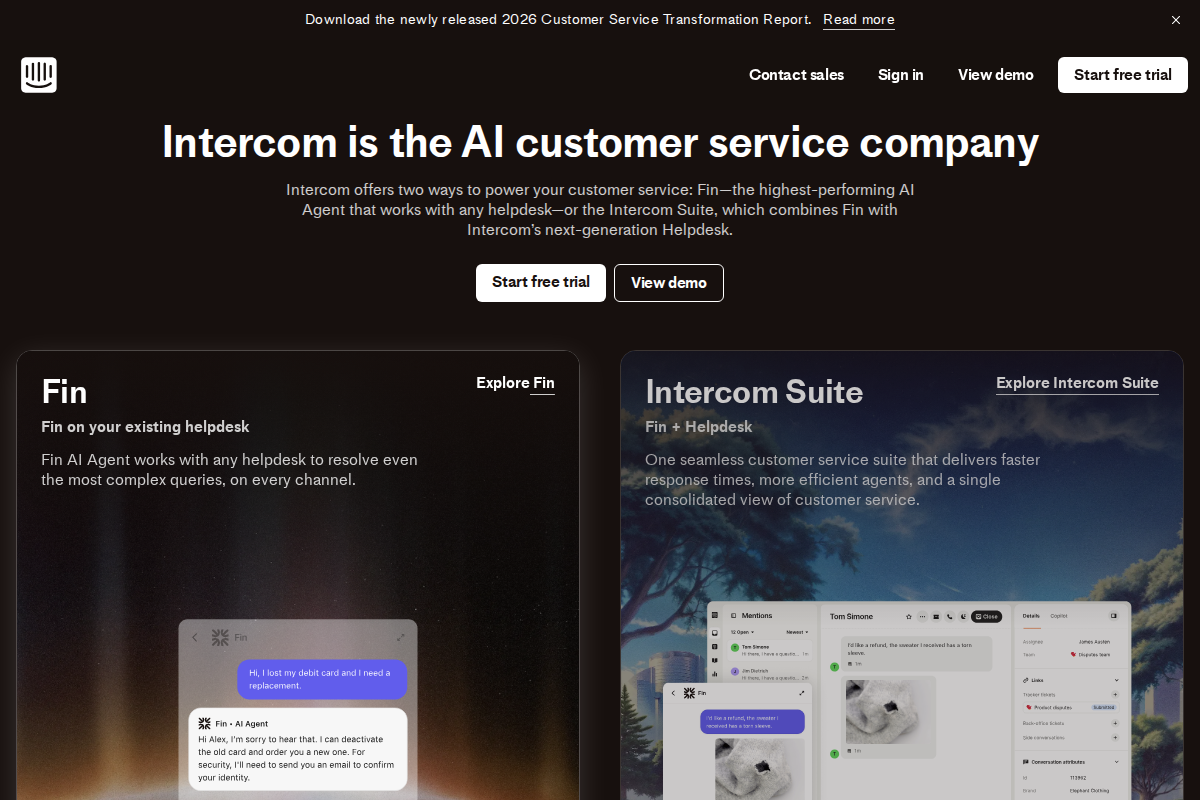
Intercom Fin and Tidio Lyro are the two most talked-about AI agents in customer service right now. Both promise to resolve the majority of your support tickets automatically, both learn from your knowledge base, and both charge based on usage rather than flat fees.
But the similarities end at the surface. Under the hood, these two platforms serve different audiences, price very differently, and make fundamentally different tradeoffs between power and simplicity.
This guide breaks down every meaningful difference so you can pick the right one for your team — not the one with the better marketing.
The Quick Verdict
Choose Tidio Lyro if you're a small-to-midsize ecommerce or SaaS team that wants a fast setup, predictable per-conversation pricing, and a platform that bundles live chat, AI, and automation in one dashboard. Lyro's 67% average resolution rate is the highest independently reported figure in the industry, and the 50-conversation free tier lets you test with real customer traffic before spending anything.
Choose Intercom Fin if you're running a larger support operation that already uses Intercom's helpdesk, or if you need multi-channel deployment across chat, email, SMS, and social media with advanced workflow automation. Fin's per-resolution pricing ($0.99) rewards high accuracy, and the platform's Copilot feature gives your human agents AI-assisted tools alongside the autonomous agent.
Resolution Rates: The Number That Actually Matters
Every AI agent vendor throws around resolution rates, but the methodology behind the number matters more than the number itself.
Tidio Lyro reports an average resolution rate of 67% across its customer base, with some individual accounts reaching as high as 90%. Tidio defines a "conversation" as a customer interaction with at least one Lyro reply — multi-message threads count as a single conversation regardless of complexity. For their premium tier, Tidio guarantees a minimum 50% resolution rate within 30 days or your money back.
The 67% figure is notable because it's reported as an industry-wide average across all Lyro deployments, not a cherry-picked case study. That said, your actual results will depend heavily on the quality and coverage of your knowledge base content. Businesses with thorough, well-organized FAQ content consistently see higher rates.
Intercom Fin reports an average resolution rate of 66% and claims this number increases by approximately 1% per month as the system improves. Fin defines resolution differently: a conversation counts as "resolved" when the customer confirms satisfaction or exits without requesting further help after Fin's last answer. If a customer reopens the conversation, the original resolution charge is reversed.
The difference in resolution definitions matters. Fin's approach means you're only paying for conversations where the customer was actually helped — an appealing model at scale. Lyro's per-conversation billing charges on the first AI reply, regardless of outcome, though at a lower per-unit cost.
Both platforms are operating in roughly the same territory for resolution effectiveness. The practical difference between 66% and 67% is negligible. What matters more is how each platform fits your specific volume, budget, and workflow needs.
Pricing: Where the Real Differences Live
This is where the two platforms diverge most sharply.
Tidio's Pricing Structure
Tidio bills based on conversation volume rather than per-agent seats. The core customer service plans scale by the number of "billable conversations" (chats where a human agent replies).
Lyro AI is billed separately as an add-on starting at $39/month for 100 AI conversations. Each conversation is charged when Lyro provides its first reply, and multi-message threads within the same session count as one conversation. If Lyro handles a dozen questions in a single customer session, that's one billable conversation.
The standalone Lyro option (without Tidio's human support tools) starts at approximately $0.58 per AI conversation, making it possible to use Lyro purely as an AI layer on top of another helpdesk like Zendesk.
For a typical small ecommerce team handling 500 total monthly conversations with Lyro resolving about 300 of them, total monthly cost lands in the range of $80-180 depending on the plan tier. See our full Tidio pricing breakdown for detailed tier comparisons.
Intercom's Pricing Structure
Intercom uses a seat-based model for the core helpdesk platform, with Fin's AI resolution charges layered on top.
Three base plans are available: Essential ($29/seat/month), Advanced ($85/seat/month), and Expert ($132/seat/month). You need at least one paid seat to use Fin. Fin itself charges $0.99 per resolved conversation , you only pay when the customer's issue is actually solved.
The critical difference: Intercom's costs can scale unpredictably. A team of five agents on the Advanced plan pays $425/month in seat costs before a single Fin resolution. If Fin then resolves 2,000 conversations, that adds $1,980 , bringing the monthly total to approximately $2,400.
Add Copilot ($35/agent/month for unlimited usage) and Proactive Support Plus ($99/month) and an enterprise-scale deployment with 15 agents and 30,000 monthly AI resolutions can reach $30,000+/month.
For smaller teams, the math works differently. A solo founder on the Essential plan with Fin resolving 200 conversations monthly pays roughly $227/month total. Our Intercom pricing guide walks through the full calculation.
Pricing Comparison at Different Scales
At low volume (under 500 monthly conversations), Tidio is almost always cheaper. At enterprise scale (10,000+ monthly conversations), the cost gap narrows because Fin's per-resolution model rewards high accuracy , you only pay for actual resolutions, not attempts.
The middle ground (500-5,000 monthly conversations) is where the comparison gets interesting and depends heavily on your team size, plan choice, and how many add-ons you need.
Setup and Time to Value
Tidio Lyro excels at fast deployment. You can install the chat widget on your website in minutes (native integrations for Shopify, WordPress, WooCommerce, and other platforms), feed Lyro your FAQ content or help center URL, and have AI-powered support running the same day. The platform includes a "Playground" for testing Lyro's responses before going live.
For Shopify store owners specifically, Tidio offers a native Shopify app with deep integration , product card recommendations, cart recovery messages, and order status lookups work out of the box. We cover the Shopify-specific setup in our guide on Tidio for Shopify stores.
Intercom Fin is also designed for quick deployment , Intercom claims setup takes under an hour. Fin learns from your existing help center content, and the platform includes an AI simulation mode that lets you test Fin's performance against historical tickets before going live.
However, getting the most from Intercom typically requires more configuration: setting up custom workflows, defining escalation rules, configuring the messenger widget, and training Copilot. Teams already using Intercom will have this infrastructure in place. Teams migrating from another helpdesk face a steeper onboarding curve.
AI Technology and Knowledge Base
Tidio Lyro is powered by Claude (Anthropic's language model) combined with Tidio's proprietary fine-tuning. Tidio explicitly chose Claude because of its emphasis on being helpful, honest, and harmless. Lyro only answers based on content you provide , it won't pull information from the open internet or make up answers. This is a deliberate design choice that prioritizes accuracy and safety over breadth.
Intercom Fin runs on what Intercom calls the "Fin AI Engine," a patented architecture optimized specifically for customer service. The underlying models aren't publicly disclosed, but Fin similarly restricts responses to your approved knowledge base. Fin Supports "Procedures" , custom instructions that define how Fin should handle specific scenarios like refund requests or account changes.
Both platforms handle multi-turn conversations, maintain context across messages, and support intelligent handoff to human agents. The practical difference is less about raw AI capability and more about the surrounding ecosystem.
Channel Support
Tidio: Website chat widget, email, Instagram, Facebook Messenger, WhatsApp. Lyro operates across all connected channels from a single inbox.
Intercom: Website chat widget, email, SMS, WhatsApp, social media, and (in limited availability) phone via Fin Voice. Intercom's channel breadth is wider, particularly with SMS and voice support.
If your support volume comes primarily through website chat and email, both platforms cover your needs. If you need phone or SMS automation, Intercom currently offers more options.
Who Each Platform Actually Serves Best
Tidio Lyro Is Built For:
Ecommerce stores on Shopify, WooCommerce, or WordPress. The native integrations, cart recovery features, and product recommendation capabilities make Lyro particularly strong for online retail. The conversation-based pricing model aligns well with seasonal traffic patterns.
Small to midsize teams (1-10 agents). Tidio's bundled approach , live chat, AI agent, chatbot flows, and helpdesk in one platform , means you're not paying for multiple tools. For a 3-person support team, total monthly cost typically stays under $200.
Teams that want simplicity. If you want an AI agent running on your website by tomorrow afternoon with minimal configuration, Lyro delivers. The tradeoff is less customization than enterprise platforms offer.
For a deeper look at Lyro in specific contexts, read our analysis of Tidio for ecommerce.
Intercom Fin Is Built For:
Mid-market and enterprise support teams (10-100+ agents). Intercom's workflow automation, team management, and reporting capabilities scale to large organizations. The Copilot feature adds measurable efficiency for human agents handling escalated tickets.
Companies already on Intercom. If your team is already using Intercom's helpdesk, adding Fin is the path of least resistance. You get AI automation layered directly into your existing workflows, with no migration needed.
Multi-channel support operations. If you're handling significant volume across email, chat, SMS, and social media simultaneously, Intercom's unified platform and broader channel support give it an edge.
What Neither Platform Tells You
Both platforms require good knowledge base content to perform well. An AI agent is only as good as the information it has access to. If your help center has gaps, outdated articles, or poorly organized content, your resolution rates will suffer regardless of which platform you choose. Budget time for knowledge base improvement alongside your AI agent deployment.
Per-resolution and per-conversation costs can be unpredictable. Seasonal spikes in customer volume (Black Friday for ecommerce, product launches for SaaS) can push your AI costs significantly above baseline months. Both platforms offer usage caps and alerts, but you need to set these up proactively.
Neither platform replaces your support team. At 60-70% resolution rates, roughly one in three conversations still needs a human. The agents augment your team's capacity , they don't eliminate it.
Our Recommendation
For most small and midsize teams reading this comparison, Tidio Lyro will be the better starting point. The lower cost floor, faster setup, strong ecommerce integrations, and the 50-conversation free tier make it easy to test without commitment. The reported resolution rates are top-tier, and the Claude-powered AI provides a genuine quality foundation.
Try Tidio Lyro free , you get 50 AI conversations included on every account with no credit card required.
For teams already on Intercom or teams with larger support operations (15+ agents, 5,000+ monthly conversations, multi-channel requirements), Fin makes sense because it integrates directly into your existing infrastructure and the per-resolution pricing model rewards accuracy at scale.
Compare both platforms in our AI Agent Directory alongside other customer service agents, and check our Tidio review and Intercom pricing analysis for additional context.
Frequently Asked Questions
Is Intercom Fin better than Tidio Lyro?
Neither is categorically better , they serve different audiences. Tidio Lyro offers higher reported resolution rates (67% vs 66%), lower starting costs, and faster setup for small teams. Intercom Fin offers broader channel support, more sophisticated workflow automation, and better scaling for large enterprises. Your team size, budget, existing tools, and primary support channels should drive the decision.
Can I use Tidio Lyro on top of Zendesk or another helpdesk?
Yes. Lyro can operate as a standalone AI layer integrated with other helpdesk platforms, including Zendesk. Tidio offers a standalone Lyro plan priced at approximately $0.58 per AI conversation that doesn't require subscribing to Tidio's full customer service suite.
How does Intercom Fin's per-resolution pricing work?
Fin charges $0.99 per resolved conversation. A resolution counts when the customer confirms their issue was solved or exits the conversation without requesting further help. If a customer later reopens the conversation, the resolution charge is reversed. You're never charged for conversations that Fin couldn't resolve or where the customer was transferred to a human agent.
Which AI model powers each platform?
Tidio Lyro is powered by Claude (Anthropic's AI model) with proprietary fine-tuning. Intercom Fin uses Intercom's patented "Fin AI Engine," a custom architecture built specifically for customer service. Intercom hasn't publicly disclosed the specific underlying models.
What resolution rate should I expect?
Industry averages for the leading AI agents are 60-70%. Your actual results depend on the quality and coverage of your knowledge base content. Businesses with comprehensive, well-organized FAQ content and clear support documentation consistently see rates at the higher end. Tidio guarantees at least 50% for premium customers within 30 days.
Can these AI agents handle complex issues like refunds or account changes?
Both platforms support action-oriented automation beyond simple Q&A. Tidio Lyro can process refund requests and check order status when connected to your ecommerce platform. Intercom Fin supports "Procedures" that define step-by-step handling for specific scenarios. However, most businesses configure their AI agents to escalate high-stakes actions (large refunds, account deletions) to human agents for final approval.
Try Tidio Free — AI Chat for SMBs
Live chat + AI chatbot combo for small businesses. Free plan with 50 conversations/month.
Get Started Free →
Erika A.
Pricing & Comparison SpecialistErika breaks down SaaS pricing tiers, hidden fees, and value-for-money across helpdesk and customer support tools at AgentWhispers. Her comparison frameworks help teams make informed purchasing decisions.