Tidio and Zendesk aren't natural competitors. One is a chat-focused platform with flat pricing; the other is the industry-standard helpdesk with per-agent costs. But small teams evaluating support software often end up comparing them.
Teams evaluating both tools reveal important trade-offs about simplicity versus power, flat pricing versus scalability, and chat versus omnichannel.
Quick Verdict
| Use Case | Winner |
|---|---|
| Small teams (1-5 agents) | Tidio |
| Growing teams (10+ agents) | Zendesk |
| Ecommerce stores | Tidio |
| Complex workflows | Zendesk |
| Budget-conscious | Tidio |
| Enterprise requirements | Zendesk |
Bottom line: Pick Tidio for simplicity and predictable costs under 10 agents. Choose Zendesk if you need power, customization, and room to scale beyond 20 agents.
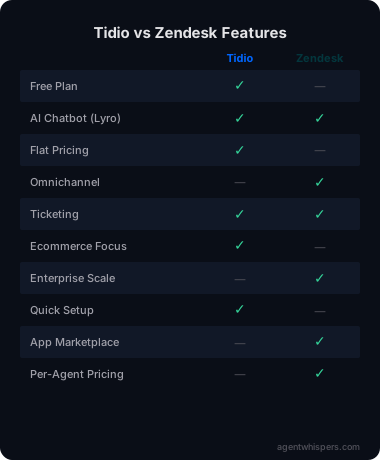
Pricing: The Fundamental Difference
Tidio's flat pricing is the headline feature. A 10-person team pays the same as a 3-person team. Zendesk's per-agent model means costs scale linearly with headcount.
But pricing isn't the full story. Zendesk's Team plan includes features Tidio locks behind higher tiers or doesn't offer at all:
- Business rules and automations
- Custom ticket fields
- Advanced reporting
- SLA management
- API access
The real cost comparison: A 5-person team on Tidio's $59 plan gets chat + basic helpdesk. The same team on Zendesk's $95 plan gets enterprise-grade ticketing with full customization. Whether the extra $36/month matters depends on your workflow complexity.
What Tidio Does Better
Ecommerce Integration
Tidio's Shopify, WooCommerce, and BigCommerce integrations are top-tier. Agents see:
- Cart contents and abandoned carts
- Browsing history
- Order history
- Lifetime value
- Product recommendations
Zendesk has ecommerce integrations, but they're lighter. You see customer data but not the rich product context Tidio provides.
For ecommerce stores, Tidio's focus pays off. Support agents become sales assistants with full customer context.
Setup Speed
Tidio: 30 minutes to first chat. Zendesk: 4-6 hours to fully configured.
Tidio's onboarding wizard asks about your platform and configures everything automatically. Zendesk requires manual setup of routing rules, custom fields, automations, and views.
If you need support software today, Tidio wins. If you have a weekend to configure properly, Zendesk's depth pays off long-term.
Chat Experience
Tidio's chat widget is modern, customizable, and loads fast. The mobile experience is smooth. Chatbots are visual and easy to build without code.
Zendesk's chat (formerly Zopim) is functional but dated. It works, but it doesn't delight.
For chat-first support, Tidio's experience is superior.
What Zendesk Does Better
Ticket Management
Zendesk invented modern ticketing. Assignment, prioritization, status tracking, and workflows are deeper than any competitor.
Tidio has tickets, but they're an add-on to chat. The ticketing features are basic: assignment, status, and notes. No complex routing, no SLA tracking, no custom workflows.
If most of your support comes through email, Zendesk is dramatically better.
Customization
Zendesk lets you customize almost everything:
- Ticket forms with conditional fields
- Business rules with 50+ trigger conditions
- Custom views and dashboards
- Branded customer portals
- API for anything else
Tidio offers customization within its framework. You can change colors and positions, but you can't fundamentally change how it works.
Reporting
Zendesk's analytics are comprehensive. You can slice data by agent, time, channel, ticket type, custom fields, and more. Export to Excel, build custom dashboards, or use the API.
Tidio's reporting covers basics: chat volume, response times, satisfaction. It's fine for small teams but doesn't scale to serious analysis.
Scalability
We've seen Zendesk deployments with 5,000+ agents. The platform handles enterprise complexity: multiple brands, global teams, complex permissions, custom integrations.
Tidio tops out around 50-100 agents. It's not built for enterprise scale.
If you're planning to grow beyond 50 support staff, Zendesk is the safer long-term bet.
Feature Comparison
| Feature | Tidio | Zendesk |
|---|---|---|
| Live chat | ✅ Excellent | ✅ Good |
| Email ticketing | ⚠️ Basic | ✅ Excellent |
| Phone support | ❌ | ✅ Add-on |
| Knowledge base | ✅ Included | ✅ Add-on |
| Chatbots | ✅ Visual builder | ⚠️ Add-on ($50/mo) |
| Ecommerce data | ✅ Deep | ⚠️ Basic |
| Custom workflows | ❌ | ✅ Extensive |
| SLA management | ❌ | ✅ Built-in |
| API | ⚠️ Limited | ✅ Comprehensive |
| Mobile app | ✅ Good | ✅ Excellent |
Real-World Scenarios
Scenario 1: 5-Person Ecommerce Team
A Shopify store doing $50K/month with 5 support agents.
Tidio wins. The ecommerce integration shows cart data and enables proactive chat. Flat pricing ($29-59/month) beats Zendesk's per-agent model. The team is small enough that Tidio's workflow limitations don't hurt.
Scenario 2: 15-Person SaaS Company
A B2B SaaS startup with complex onboarding and technical support.
Zendesk wins. The team needs email ticketing, custom workflows, and SLA tracking. Tidio's basic ticketing can't handle the complexity. The per-agent cost ($285/month) is justified by the productivity gains.
Scenario 3: Solo Founder
One person handling all support for a small product business.
Tidio wins. Free plan covers unlimited conversations. Setup takes 30 minutes. When the founder hires help, costs stay flat.
Scenario 4: Fast-Growing Marketplace
A marketplace startup planning to scale from 10 to 100 support staff in 2 years.
Zendesk wins. Migration is painful. Starting with Zendesk avoids a platform switch mid-growth. The per-agent cost stings at 10 agents but becomes reasonable at 50.
Migration Considerations
Moving from Tidio to Zendesk is possible but not seamless. You can export ticket data, but formatting and metadata don't transfer perfectly. Plan to lose some historical context.
Moving from Zendesk to Tidio is harder. Zendesk's data structure is more complex; Tidio's simpler model can't absorb it all.
If you think you might outgrow Tidio, consider starting with Zendesk. The migration cost in time and lost data often exceeds the early-stage savings.
The Verdict
Pick Tidio if:
- You have 1-10 support agents
- You run an ecommerce store
- You want chat + basic helpdesk together
- Budget predictability matters
- You need to be live today
Pick Zendesk if:
- You have 10+ agents or plan to soon
- Email is your primary support channel
- You need custom workflows or SLA tracking
- You're building a long-term support operation
- You can invest in proper setup
Don't pick either if:
- You need phone support included (consider Freshdesk)
- You want the deepest ecommerce integration (consider Gorgias)
- You need AI-first support (consider Intercom)
- Zendesk review — Full Zendesk analysis
- Tidio review — In-depth Tidio review
- Zendesk vs Freshdesk — Zendesk alternatives
Related Articles
- How to Choose Helpdesk Software — Selection framework
- Best Helpdesk for Small Business — Top picks
What Real Users Say About Tidio
Overall sentiment: Tidio receives positive reviews for its easy-to-use interface and AI chatbot Lyro at competitive pricing, though users criticize automatic plan upgrades and limited widget customization.
What users consistently praise:
Capterra and SoftwareAdvice reviews highlight Tidio's intuitive dashboard that new agents learn quickly, with one user noting "options of free plans as well, AI chatbot automation, real time visitor monitoring." SoftwareReviews validates praise for reliability and unique features. The Lyro AI bot receives specific mention for automating responses, though users note its learning remains limited to websites and FAQs rather than broader knowledge bases. Ecommerce store owners on Reddit report setup taking "minutes" with easy backend navigation.
Recurring complaints:
Trustpilot reviews document concerns with unresponsiveness from support teams and lack of clear explanations for account issues. Voiceflow notes add-ons and branding removal "can be expensive for AI agencies and small businesses." Reddit r/WordpressPlugins users criticize limited widget customization — "you can only change simple things like fonts and background color" — and mobile app logout issues requiring frequent re-authentication. The separation between Lyro AI and rule-based chatbots creates confusion about which automation to use.
The non-obvious takeaway:
Trustpilot data reveals a pattern where long-term Tidio users ("from the very beginning") express disappointment with recent changes, describing the company as evolving from "a promising new startup with smooth, user-friendly, and reliable software" to a more corporate entity with support quality decline — suggesting growth-stage struggles that affected core user experience for early adopters.
Sources: Capterra, SoftwareAdvice, SoftwareReviews, Trustpilot, Voiceflow, Reddit. Data aggregated February 2026.
What Real Users Say About Zendesk
Overall sentiment: Zendesk maintains a 4.2/5 rating on G2 but only 3.8/5 on Trustpilot, with enterprise users praising scalability while small teams criticize hidden costs and complexity starting at $19/agent/month.
What users consistently praise:
TechRadar and Hiver reviews emphasize multi-channel support capabilities and solid ticketing management as primary strengths. Enterprise users on Reddit (midsized software companies) specifically value the employee service portal for IT requests and incident management features. The automation tools and omnichannel integration receive consistent positive mentions across review platforms for handling complex support workflows at scale.
Recurring complaints:
Trustpilot reviews (December 2025) reveal frustration with Zendesk's own customer support responsiveness, creating irony given the platform's purpose. Multiple users cite "hidden costs" and complex setup as barriers, with pricing concerns particularly acute for teams under 10 agents. Reddit discussions in r/Zendesk highlight limitations as an ITSM tool, with users noting restricted views and poor CSV export functionality for technical support use cases.
The non-obvious takeaway:
A pattern emerging across Reddit and Trustpilot shows that Zendesk's enterprise-focused pricing (plans exceeding $100/agent with add-ons) creates a "mid-market gap" — growing companies between 15-50 agents frequently seek alternatives not for missing features, but because they're paying enterprise prices without receiving enterprise-grade support responsiveness from Zendesk itself.
Sources: TechRadar, Hiver, Trustpilot, Reddit, G2. Data aggregated February 2026.
Frequently Asked Questions
Can Tidio replace Zendesk completely?
For small teams with simple workflows, yes. For teams needing complex ticket routing, SLA tracking, or advanced reporting, no. Tidio is chat-first; Zendesk is helpdesk-first.
Is Zendesk worth the price premium?
For teams of 10+ with complex needs, yes. The productivity gains from automation, custom workflows, and better reporting offset the cost. For smaller teams, probably not.
Which has better ecommerce features?
Tidio, by a significant margin. The product cards, cart tracking, and proactive messaging are purpose-built for online stores. Zendesk's ecommerce integrations are functional but lighter.
Can I use Tidio chat with Zendesk tickets?
Yes, through Zapier or Zendesk's chat integration. But this adds complexity and cost. If you need both, consider whether Zendesk's built-in chat (or a different tool) makes more sense.
How do I migrate between them?
Both platforms offer data export. Tidio exports to CSV; Zendesk exports to JSON. You'll lose some formatting and metadata in any migration. Professional migration services exist but cost $2,000-5,000.
Which has better AI features?
Tidio includes basic AI chatbots in paid plans. Zendesk offers AI through their Advanced AI add-on ($50/agent). Neither matches Intercom or specialized AI tools for advanced features.

Erika A.
Pricing & Comparison SpecialistErika breaks down SaaS pricing tiers, hidden fees, and value-for-money across helpdesk and customer support tools at AgentWhispers. Her comparison frameworks help teams make informed purchasing decisions.