Zendesk and Intercom solve different problems. Zendesk handles support tickets efficiently. Intercom engages customers proactively. They're not direct competitors — but many businesses evaluate both when choosing customer communication software.
Understanding their different philosophies helps you pick the right tool (or combination) for your needs. For detailed pricing on both platforms, see our Zendesk pricing breakdown and Intercom pricing analysis.
Quick Verdict
| Use Case | Winner |
|---|---|
| Ticket management | Zendesk |
| Proactive messaging | Intercom |
| Email support | Zendesk |
| In-app messaging | Intercom |
| Ease of setup | Zendesk |
| AI features | Intercom |
| Pricing | Zendesk |
| Ecommerce | Intercom |
Bottom line: Pick Zendesk if you need traditional helpdesk software for reactive support. Choose Intercom if you want to proactively engage customers and prevent tickets before they happen.
Pricing Compared
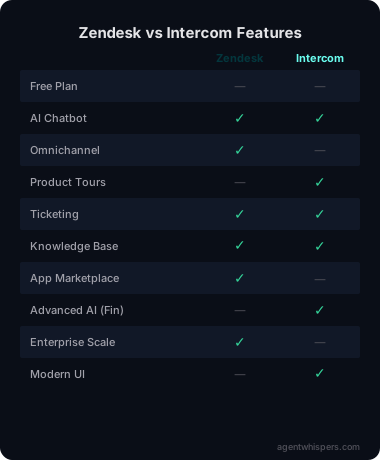
Intercom is significantly more expensive. You're paying for proactive messaging, product tours, and AI features that Zendesk doesn't offer.
Core Philosophy
Zendesk: Reactive support. Customers contact you with problems; you solve them efficiently. Ticket → Agent → Resolution.
Intercom: Proactive engagement. You reach customers before they contact you. Message → Engagement → Prevention.
This philosophical difference shapes everything from features to pricing to implementation.
Ticket Management
Zendesk wins. This is Zendesk's home turf. Comprehensive ticket handling:
- Advanced routing and assignment
- SLA management and tracking
- Custom fields and workflows
- Deep reporting and analytics
Intercom has tickets, but they're an add-on to messaging. The ticketing features are basic compared to Zendesk.
If ticket volume exceeds 100 daily, Zendesk's superior management becomes essential.
Proactive Messaging
Intercom wins. This is Intercom's specialty. Product tours, in-app messages, behavior-based campaigns:
- Onboarding sequences for new users
- Feature announcements to power users
- Re-engagement for churning customers
- Targeted messages based on behavior
Zendesk has some proactive features, but Intercom's are more sophisticated and easier to implement. The campaign builder lets non-technical users create sophisticated trigger sequences.
In-App Messaging
Intercom wins. The messenger is beautiful, customizable, and feels like part of your product. Users can start conversations from anywhere in your app.
Zendesk's chat widget is functional but dated. It works, but doesn't delight.
For SaaS companies where the product is the primary experience, Intercom's messenger fits better. The modern design matches contemporary app aesthetics.
AI Features
Intercom wins. Fin AI is genuinely impressive. It reads your help center and answers questions instantly — often before customers realize they need help.
Zendesk has AI features (routing, sentiment analysis, answer bot), but Intercom's are more advanced and user-friendly.
Ease of Setup
Zendesk wins. You can have basic ticketing running in hours. The learning curve is gentler.
Intercom setup is more complex. You're configuring messaging workflows, not just ticket queues. Plan for several days to set up properly.
Email Support
Zendesk wins. Email is Zendesk's native channel. Full-featured, reliable, deeply integrated.
Intercom handles email but treats it as secondary to messaging. Email features are lighter.
If email is your primary support channel, Zendesk is the clear choice.
Ecommerce
Intercom wins. Product cards in chat, order tracking, and integration with Shopify/WooCommerce make it stronger for online stores.
Zendesk has ecommerce integrations, but Intercom's are more polished and conversion-focused.
Real-World Scenarios
Scenario 1: B2B SaaS Company
Product-led growth with 10,000+ users.
Winner: Intercom. Proactive onboarding, feature announcements, and churn prevention drive growth. The $200-400/month cost is justified by reduced churn and higher activation.
Scenario 2: Ecommerce Store
200 orders daily, mostly email support.
Winner: Zendesk. Better email handling, more affordable at $95/month vs Intercom's $199+, and sufficient for reactive support needs.
Scenario 3: Enterprise IT Support
500 employees, complex internal support.
Winner: Zendesk. Advanced routing, SLA management, and enterprise features Intercom lacks.
Scenario 4: Mobile App Company
Consumer app with millions of users.
Winner: Intercom. In-app messaging, proactive engagement, and user onboarding that Zendesk can't match.
Using Both Together
Many companies use both: Zendesk for ticket management, Intercom for proactive messaging. They integrate via Zapier or API.
This gives you Zendesk's ticket power + Intercom's messaging capabilities. But it's expensive and complex to manage two platforms.
The Verdict
Pick Zendesk if:
- Email is your primary support channel
- You handle 100+ tickets daily
- Advanced ticket routing and SLAs matter
- Budget is a concern
- You need traditional helpdesk software
Pick Intercom if:
- You're a SaaS/product company
- User activation and retention drive your business
- You want proactive, not just reactive, support
- In-app messaging is important
- Budget allows for premium pricing
Don't pick either if:
- You just need simple live chat (consider Tidio)
- You want free helpdesk software (consider Freshdesk)
- You're purely ecommerce (consider Gorgias)
Related Articles
- Zendesk vs Freshdesk — Feature comparison
- How to Choose Helpdesk Software — Selection framework
- Best Helpdesk for Small Business — Top picks
What Real Users Say About Zendesk
Overall sentiment: Zendesk maintains a 4.2/5 rating on G2 but only 3.8/5 on Trustpilot, with enterprise users praising scalability while small teams criticize hidden costs and complexity starting at $19/agent/month.
What users consistently praise:
TechRadar and Hiver reviews emphasize multi-channel support capabilities and robust ticketing management as primary strengths. Enterprise users on Reddit (midsized software companies) specifically value the employee service portal for IT requests and incident management features. The automation tools and omnichannel integration receive consistent positive mentions across review platforms for handling complex support workflows at scale.
Recurring complaints:
Trustpilot reviews (December 2025) reveal frustration with Zendesk's own customer support responsiveness, creating irony given the platform's purpose. Multiple users cite "hidden costs" and complex setup as barriers, with pricing concerns particularly acute for teams under 10 agents. Reddit discussions in r/Zendesk highlight limitations as an ITSM tool, with users noting restricted views and poor CSV export functionality for technical support use cases.
The non-obvious takeaway:
A pattern emerging across Reddit and Trustpilot shows that Zendesk's enterprise-focused pricing (plans exceeding $100/agent with add-ons) creates a "mid-market gap" — growing companies between 15-50 agents frequently seek alternatives not for missing features, but because they're paying enterprise prices without receiving enterprise-grade support responsiveness from Zendesk itself.
Sources: TechRadar, Hiver, Trustpilot, Reddit, G2. Data aggregated February 2026.
What Real Users Say About Intercom
Overall sentiment: Intercom receives mixed reviews with praise for AI capabilities but criticism for pricing exceeding $100/agent/month and slow support response times, particularly following the shift to AI-first positioning.
What users consistently praise:
Headwestguide and Sparrowdesk reviews highlight Intercom's comprehensive customer interaction platform, with the Messenger serving as a centralized hub for personalized communication. The Fin AI chatbot receives specific praise for resolving up to 50% of support queries autonomously. Integration capabilities with major CRMs and the visual workflow builder satisfy teams wanting sophisticated automation. Enterprise users value the omnichannel approach combining in-app messaging, email, and chat into unified customer profiles.
Recurring complaints:
Trustpilot reviews document frustration with slow support response times — ironic given Intercom's positioning as a support platform. Pricing criticism dominates recent reviews: Featurebase notes costs often exceed $100/seat/month with hidden AI resolution fees ($0.99 per AI resolution adds ~$1,000/month at 1,000 automated inquiries). Chameleon and Reddit r/SaaS users report aggressive pricing hikes and complex seat-based licensing that forces "awkward access patterns" where teams limit logins despite needing broader visibility. Recent updates prioritizing AI over traditional support features alienated some long-term users.
The non-obvious takeaway:
Reddit r/ProductManagement discussions reveal a pattern where Intercom's AI-first pivot created a bifurcated user base — companies wanting advanced automation praise the direction while those needing reliable traditional support express betrayal, suggesting Intercom's strategic shift satisfied one market segment while abandoning another without clear communication.
Sources: Headwestguide, Sparrowdesk, Trustpilot, Featurebase, Chameleon, Reddit. Data aggregated February 2026.
Frequently Asked Questions
Can Intercom replace Zendesk completely?
For small teams (under 10 agents) with simple needs, yes. For larger teams or complex workflows, you'll miss Zendesk's ticket management.
Is Intercom worth 3x Zendesk's price?
For product companies where user engagement drives revenue, yes. For pure support, probably not.
Which has better chat?
Intercom. The messenger is modern, customizable, and feels native to your product. Zendesk's chat widget is functional but dated.
Can I use both together?
Yes. Many companies use Intercom for messaging/proactive support and Zendesk for ticket management. But managing two platforms adds complexity.
Which is easier to set up?
Zendesk. You can be running in hours. Intercom requires more configuration for messaging workflows.

Erika A.
Pricing & Comparison SpecialistErika breaks down SaaS pricing tiers, hidden fees, and value-for-money across helpdesk and customer support tools at AgentWhispers. Her comparison frameworks help teams make informed purchasing decisions.