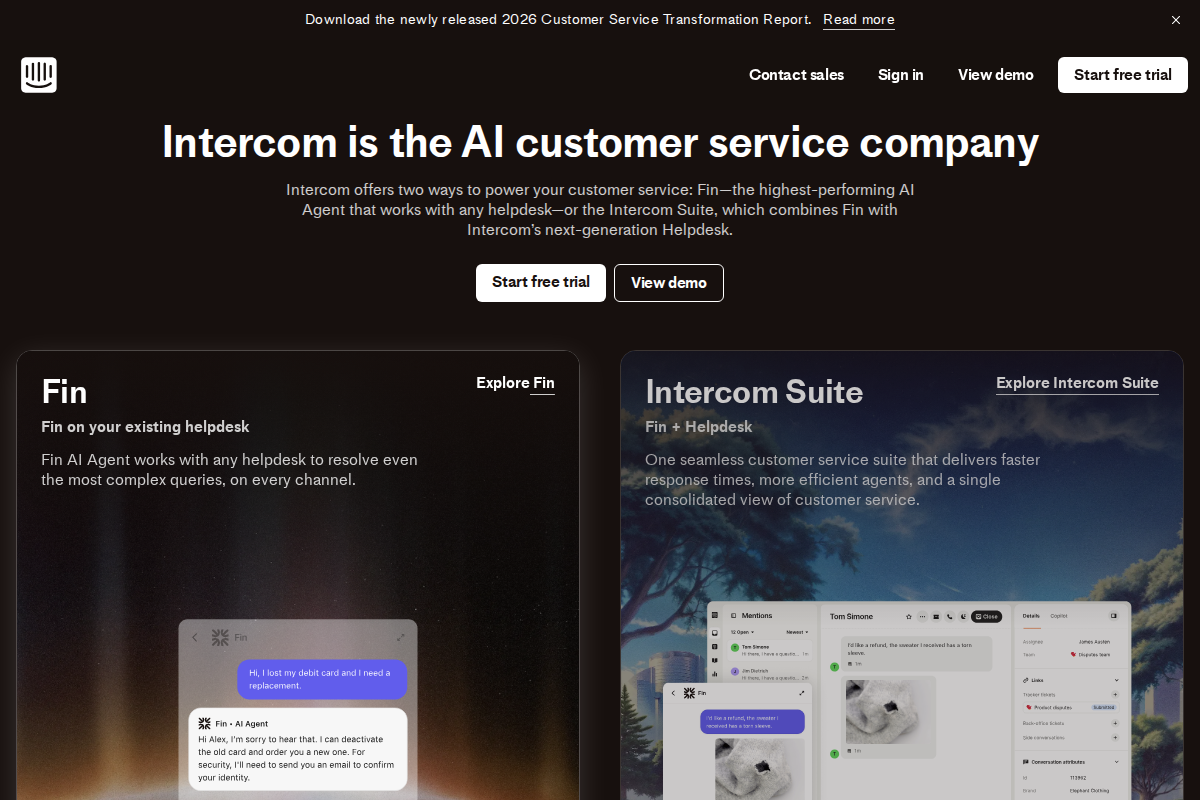
Intercom and HubSpot both help you engage customers proactively. Intercom specializes in product messaging and user onboarding. HubSpot unifies marketing, sales, and support in one platform.
They're not direct competitors, but both appear when researching "customer engagement platforms." Understanding their different approaches helps you pick the right tool.
Quick Verdict
| Use Case | Winner |
|---|---|
| In-app messaging | Intercom |
| CRM integration | HubSpot |
| Product onboarding | Intercom |
| Marketing automation | HubSpot |
| Support tickets | HubSpot |
| AI features | Intercom |
| Unified platform | HubSpot |
| SaaS focus | Intercom |
Bottom line: Pick Intercom if you're a SaaS company wanting sophisticated product messaging and onboarding. Choose HubSpot if you want a unified CRM, marketing, and support platform.
Pricing Compared
Intercom charges per month (not per agent), which can be cheaper for larger teams. HubSpot's per-agent pricing adds up quickly.
Core Philosophy
Intercom: Product-centric engagement. Reach users inside your app with targeted messages, product tours, and proactive support.
HubSpot: Customer-centric platform. Unify marketing, sales, and support data to engage customers across their entire journey.
In-App Messaging
Intercom wins. This is Intercom's core strength. The Messenger is:
- Beautiful and customizable
- Native-feeling in your product
- Contextual (shows based on user behavior)
- Multi-functional (chat, tours, announcements)
HubSpot has chat, but it's not as sophisticated or product-native as Intercom. While HubSpot's chat widget works well for sales and support on websites, it lacks the contextual awareness and behavioral triggers that make Intercom feel like a native part of your product. For SaaS companies where the in-app experience is central to customer success, this difference matters significantly.
Product Onboarding
Intercom wins. Product tours, tooltips, and onboarding flows are core Intercom features. You can build sophisticated walkthroughs without code.
HubSpot offers some onboarding capabilities, but they're not as polished or product-focused.
For SaaS companies, Intercom's onboarding tools are essential.
CRM Integration
HubSpot wins. This is HubSpot's advantage. Native CRM means:
- Customer data flows seamlessly between teams
- Support sees sales history
- Marketing sees support interactions
- Unified reporting across the customer journey
Intercom has some CRM capabilities, but they're not as deep as HubSpot's.
Marketing Automation
HubSpot wins. Email marketing, lead nurturing, and campaign management are core HubSpot features.
Intercom offers email and messaging campaigns, but HubSpot's marketing automation is more sophisticated.
Support Tickets
HubSpot wins. While neither is primarily a ticketing system, HubSpot Service Hub handles tickets better than Intercom.
Intercom treats tickets as part of conversations. HubSpot has more structured ticket management.
AI Features
Intercom wins. Fin AI is genuinely impressive. It reads your help center and answers questions instantly.
HubSpot has AI features (content assistant, smart routing), but Intercom's are more advanced for support use cases.
Real-World Scenarios
Scenario 1: SaaS Company Focused on Activation
Product-led growth, need user onboarding and engagement.
Winner: Intercom. Product tours, in-app messaging, and proactive engagement drive activation.
Scenario 2: B2B Company with Complex Sales
Long sales cycles, need marketing + sales + support alignment.
Winner: HubSpot. Unified CRM platform keeps teams aligned and data connected.
Scenario 3: Startup on Tight Budget
Need engagement tools but money is tight.
Winner: HubSpot free tier. Covers basic needs at zero cost. Upgrade when you grow.
Scenario 4: Growth-Stage Company
50 employees, need both product engagement and CRM.
Winner: Both. Use Intercom for product messaging, HubSpot for CRM and marketing. Integration connects them.
Using Both Together
Many growth-stage companies use both:
- Intercom: Product messaging, onboarding, in-app support
- HubSpot: CRM, marketing automation, sales pipeline
They integrate well. Intercom data flows to HubSpot contacts; HubSpot data personalizes Intercom messages.
This gives you the best of both worlds but costs more and adds complexity.
The Verdict
Pick Intercom if:
- You're a SaaS or product company
- In-app messaging is critical
- User onboarding drives your metrics
- Product-led growth is your strategy
- You want sophisticated proactive engagement
Pick HubSpot if:
- You want unified CRM, marketing, and support
- Sales and marketing alignment matters
- You need comprehensive customer data
- You're building a customer-centric organization
- You value breadth over depth in messaging
Don't pick either if:
- You need pure helpdesk (consider Zendesk or Freshdesk)
- You want simple, cheap chat (consider Tidio)
- You're pure ecommerce (consider Gorgias)
Related Articles
- How to Choose Helpdesk Software — Selection framework
- Best Helpdesk for Small Business — Top picks
What Real Users Say About Intercom
Overall sentiment: Intercom receives mixed reviews with praise for AI capabilities but criticism for pricing exceeding $100/agent/month and slow support response times, particularly following the shift to AI-first positioning.
What users consistently praise:
Headwestguide and Sparrowdesk reviews highlight Intercom's comprehensive customer interaction platform, with the Messenger serving as a centralized hub for personalized communication. The Fin AI chatbot receives specific praise for resolving up to 50% of support queries autonomously. Integration capabilities with major CRMs and the visual workflow builder satisfy teams wanting sophisticated automation. Enterprise users value the omnichannel approach combining in-app messaging, email, and chat into unified customer profiles.
Recurring complaints:
Trustpilot reviews document frustration with slow support response times — ironic given Intercom's positioning as a support platform. Pricing criticism dominates recent reviews: Featurebase notes costs often exceed $100/seat/month with hidden AI resolution fees ($0.99 per AI resolution adds ~$1,000/month at 1,000 automated inquiries). Chameleon and Reddit r/SaaS users report aggressive pricing hikes and complex seat-based licensing that forces "awkward access patterns" where teams limit logins despite needing broader visibility. Recent updates prioritizing AI over traditional support features alienated some long-term users.
The non-obvious takeaway:
Reddit r/ProductManagement discussions reveal a pattern where Intercom's AI-first pivot created a bifurcated user base — companies wanting advanced automation praise the direction while those needing reliable traditional support express betrayal, suggesting Intercom's strategic shift satisfied one market segment while abandoning another without clear communication.
Sources: Headwestguide, Sparrowdesk, Trustpilot, Featurebase, Chameleon, Reddit. Data aggregated February 2026.
What Real Users Say About HubSpot Service Hub
Overall sentiment: HubSpot Service Hub holds a 4.3/5 rating on G2 with 313 mentions praising ease of use, but faces criticism for pricing starting at $90/agent/month and slow customer support response times.
What users consistently praise:
G2 reviews emphasize the platform's user-friendly interface with "exceptional" ease of use streamlining customer support workflows. The all-in-one CRM integration — connecting marketing, sales, and service data — receives consistent praise from teams wanting unified customer views. Lagrowthmachine notes the free CRM tier includes unlimited users, providing genuine value for startups testing the platform. Automation capabilities and comprehensive reporting tools satisfy teams needing sophisticated workflow management without technical complexity.
Recurring complaints:
Trustpilot reviews (January 2026) document significant customer service issues, with one user describing "unprofessional, disrespectful" support interactions when trying to resolve plan issues. Pricing escalates quickly — Tldv.io and Featurebase note the steep costs when scaling, with Marketing + Service Hub Professional reaching $3,500-$4,500/month compared to best-of-breed alternatives at $900-$1,400. The learning curve for beginners remains substantial despite the intuitive interface. Integration troubleshooting with third-party tools creates frustration according to SmartBugMedia reviews.
The non-obvious takeaway:
Reddit r/hubspot discussions reveal a common pattern where companies adopt Service Hub for its CRM integration but later face "suite lock-in" — the convenience of unified data makes migrating individual components (service, marketing, sales) prohibitively expensive and complex, effectively trapping growing companies in pricing tiers that outpace their budget.
Sources: G2, Lagrowthmachine, Trustpilot, Tldv.io, Featurebase, Reddit. Data aggregated February 2026.
Frequently Asked Questions
Is Intercom or HubSpot better?
Different use cases. Intercom for product messaging, HubSpot for unified CRM + support.
Can I use both together?
Yes. Many companies use Intercom for product engagement and HubSpot for CRM/marketing.
Which has better chat?
Intercom for in-app, HubSpot for website/sales chat.
Is Intercom worth the price?
For SaaS companies where engagement drives retention, yes. For traditional businesses, probably not.
Which should I choose as a startup?
HubSpot free tier to start. Add Intercom when product engagement becomes critical.
How do their mobile apps compare?
Both offer mobile apps, but with different focuses. Intercom's mobile app is designed for quick customer conversations and inbox management on the go. HubSpot's mobile app provides broader CRM access—viewing contacts, deals, and marketing performance alongside support tickets. For sales teams in the field, HubSpot's mobile experience is more comprehensive.
Which has better email capabilities?
HubSpot wins decisively on email. Its email marketing platform includes drag-and-drop builders, A/B testing, personalization tokens, and detailed analytics. Intercom offers email campaigns as part of its messaging suite, but the capabilities are more basic compared to HubSpot's dedicated email infrastructure.

Erika A.
Pricing & Comparison SpecialistErika breaks down SaaS pricing tiers, hidden fees, and value-for-money across helpdesk and customer support tools at AgentWhispers. Her comparison frameworks help teams make informed purchasing decisions.